
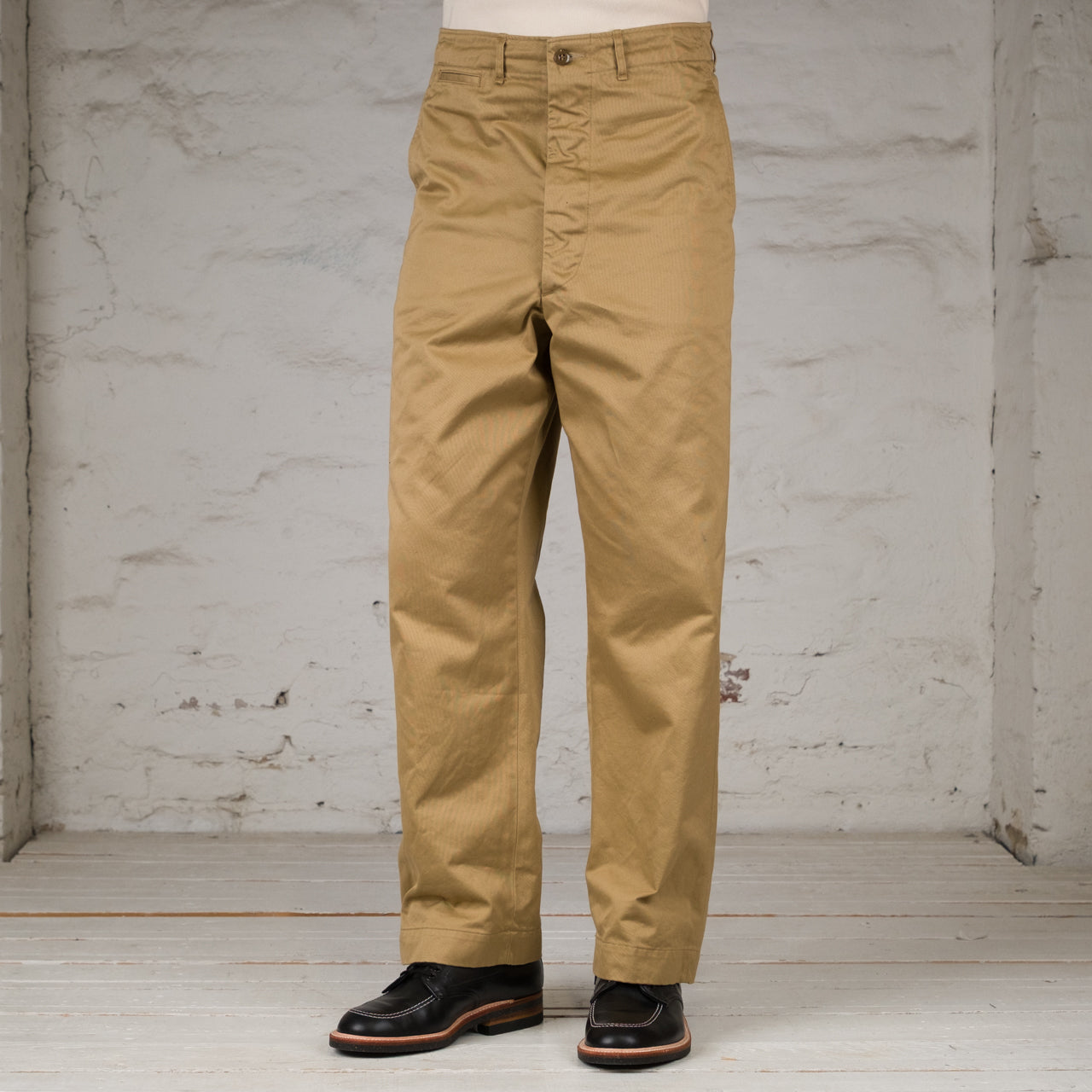
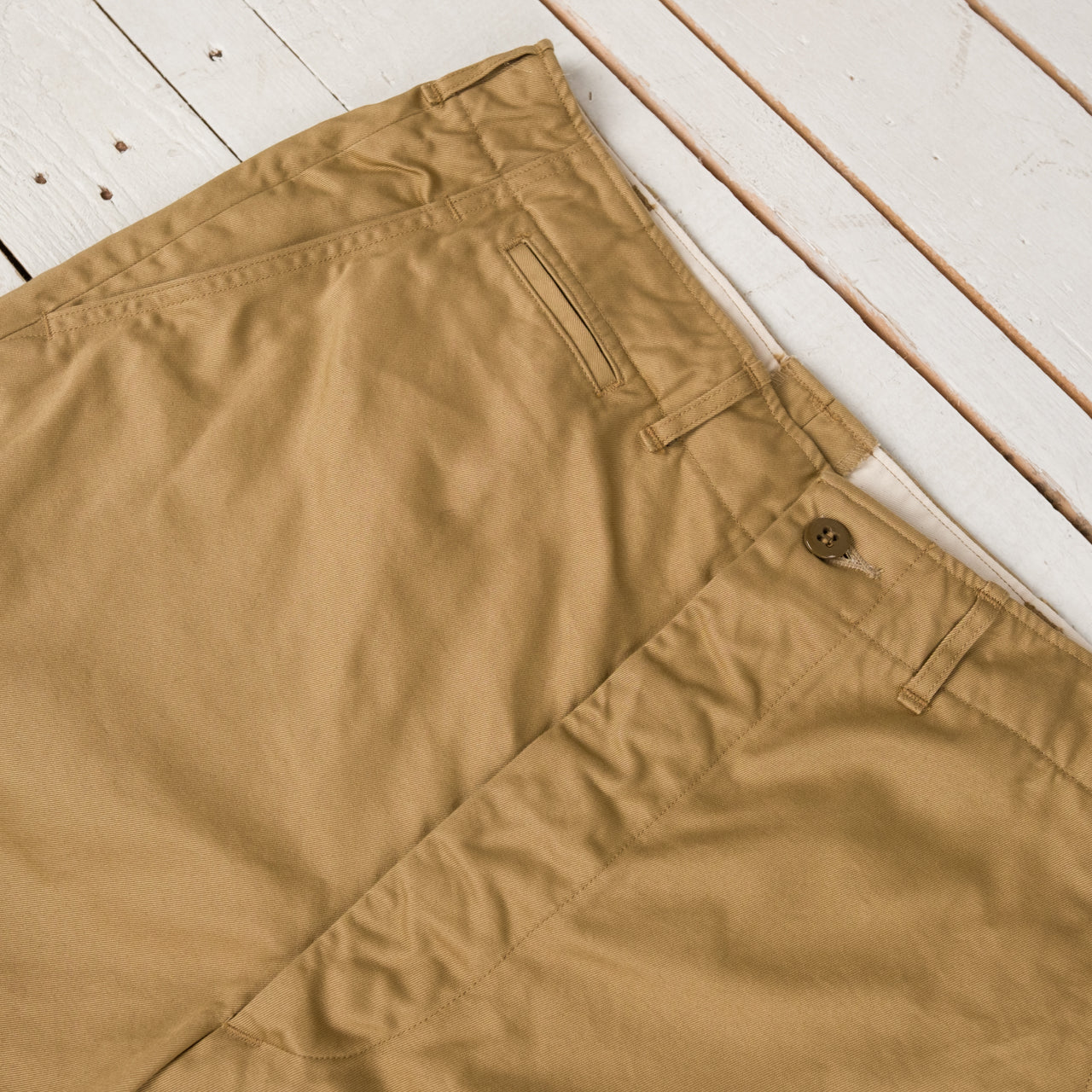
Like so many iconic pieces of menswear, the chino has its roots in military clothing. In fact, it makes for an interesting case study in how a piece of uniform can evolve into an entirely civilian staple. The direct ancestor of the modern chino is the US Army’s cotton khaki trouser, although the story begins considerably earlier than that.
The first chapter takes us to India’s North-West Frontier in the late 1840s, when the Corps of Guides began replacing conspicuous uniforms with loose cotton clothing dyed a dusty drab. The colour became known as khaki, from the Hindustani word for “dust-coloured”, and over the following decades khaki clothing spread through the British Army as practical hot-weather uniform. The US Army adopted khaki cotton at the end of the century, initially largely in the form of breeches. The trousers we would recognise as the immediate ancestors of the chino arrived in the late 1930s, when cotton khaki trousers began replacing breeches across the Army. After the Second World War, veterans, surplus clothing and eventually American college campuses helped carry them firmly into civilian life.
Now, the name “chino” is where things get a little more complicated and, as with many details of menswear history, surprisingly hotly debated. One commonly repeated explanation connects the trousers to cotton cloth produced in China and traded through the Philippines, with chino simply being the Spanish word for “Chinese”. It certainly makes sense, but the word itself only begins appearing in print in the 1940s, and dictionaries offer other possible origins. The historical record is not quite definitive enough for us to risk upsetting the more rabid corners of menswear Reddit by declaring a winner.
What Makes a Chino a Chino?
The chino sits somewhere between a pair of dress trousers and workwear: cleaner and more structured than a fatigue pant, but simpler and less formal than traditional tailoring. There isn’t one single feature that turns a pair of trousers into a chino.
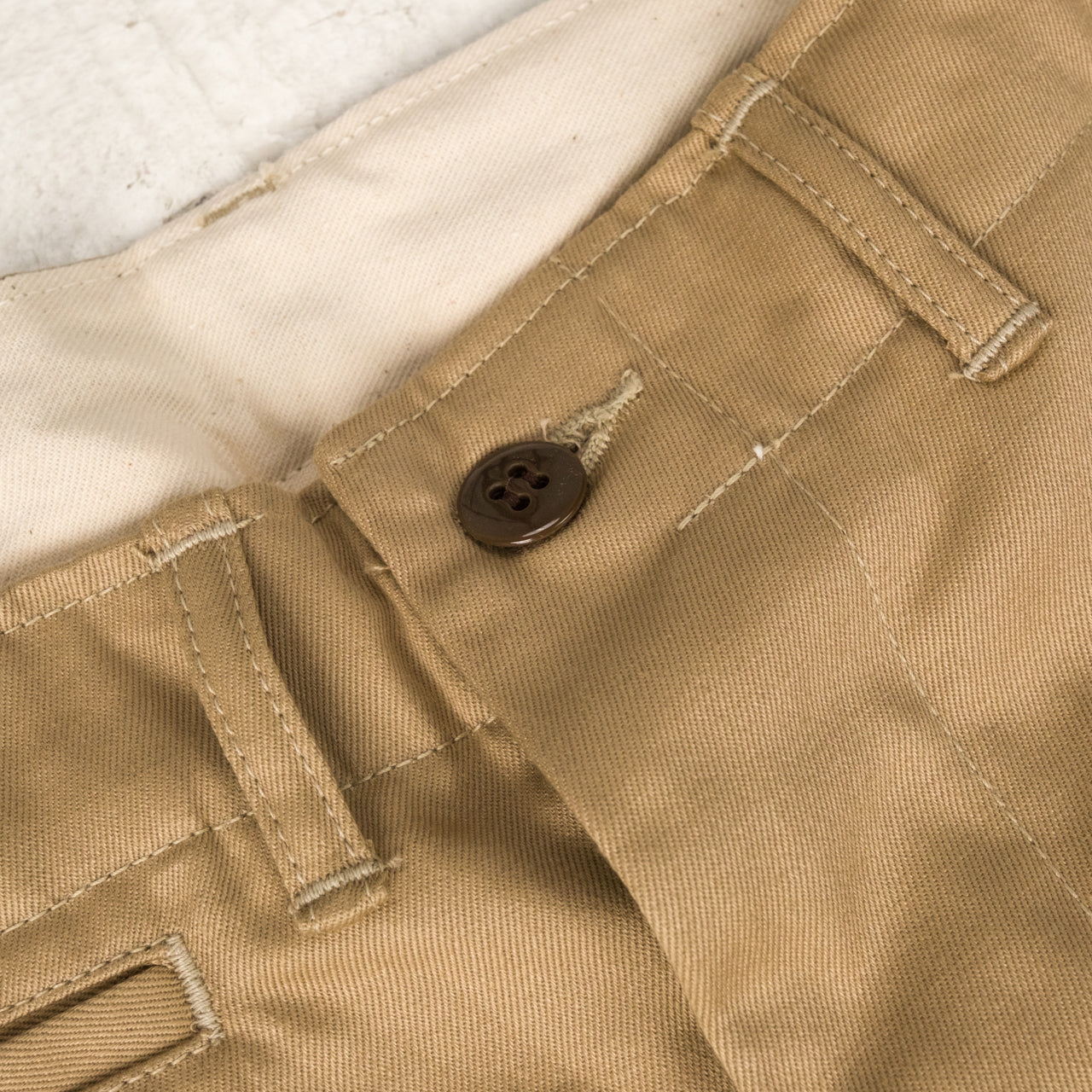
The classic chino usually has slanted side pockets rather than the curved scoop pockets of five-pocket jeans, one or two welt pockets at the rear, a constructed waistband and either a button or zip fly.
Take away some of the refinement and add external utility pockets and you begin moving towards fatigues and field trousers. Add finer cloth, more structured tailoring and traditional dress-trouser details and you move in the other direction. The chino has endured because it occupies the remarkably useful space between the two.
The Makers: From Reproduction to Interpretation
Some are interested in reproducing a particular military garment almost stitch for stitch. Others start with the same history and allow themselves considerably more freedom with the cloth, proportions and fit.
The Real McCoy’s sits firmly towards the reproduction end of that spectrum. Its Khaki 1945 is based on the final wartime generation of US Army khaki trousers and their post-war continuation, with details such as flat-felled seams, single-welt pockets, urea buttons and cotton sewing thread treated not as decorative vintage touches, but as part of reconstructing how the originals were actually made.
Buzz Rickson’s takes a similarly serious approach to military reproduction. Its 1942 Model recreates the 1942-pattern US Army khaki trouser with a deep rise, roomy straight leg, double-needle felled seams, double-welt rear pockets and metal US Army buttons.
Jelado approaches historical accuracy from another direction entirely. Rather than working only from a specification or archive pattern, the company took apart surviving examples of the 1941-era Army khakis collectors often call “M41s” and analysed the fabric itself: yarn thickness, irregularity, twist count and twist direction. It is less a case of designing a vintage-looking chino than reverse-engineering one.
Warehouse approaches the chino through the cloth. Its Lot 1082 uses a dense, sulphur-dyed selvedge twill that Warehouse calls weapon cloth, closely related to the family of fabrics generally referred to as West Point. It begins crisp and structured and gradually relaxes as it is washed and worn.
orSlow starts in similar military territory but takes a freer approach. The military DNA is obvious, but the result still feels unmistakably like orSlow: relaxed, slightly idiosyncratic and designed around how the trousers actually live on the person wearing them.
Iron Heart brings its denim thinking to the chino. The IH-730 uses a substantial 12 oz cloth, while the IH-717 moves to a lighter 9 oz mercerised selvedge fabric and uses Iron Heart’s familiar 634 straight fit as its starting point.
Freenote’s Deck Pant sits decidedly towards the workwear end of the scale. Freenote itself describes it as an outdoorsman’s chino, with a higher rise, roomier thigh and wider hem than its Workers Chino. A substantial 14 oz Japanese slub cotton gives it considerably more body than a conventional lightweight chino.
Black Sign takes us onto another branch of the military family tree. Its Gurkha trousers aren’t strictly chinos at all. As with most things Black Sign makes, the result is less interesting because it fits neatly into a category than because it doesn’t.
Tela Genova takes us away from American military reproduction and towards Italy. The Renzo and Rodrigo are cut from cotton gabardine, with button flies and jetted rear pockets, and to our eyes sit towards the more sartorial edge of the chino family.
Chino Cloth, West Point, Gabardine and More
The silhouette may define the chino, but the cloth determines much of its character. Two pairs cut to almost identical measurements can feel completely different depending on the yarn, weave, weight and finishing of the fabric.
Chino Cloth
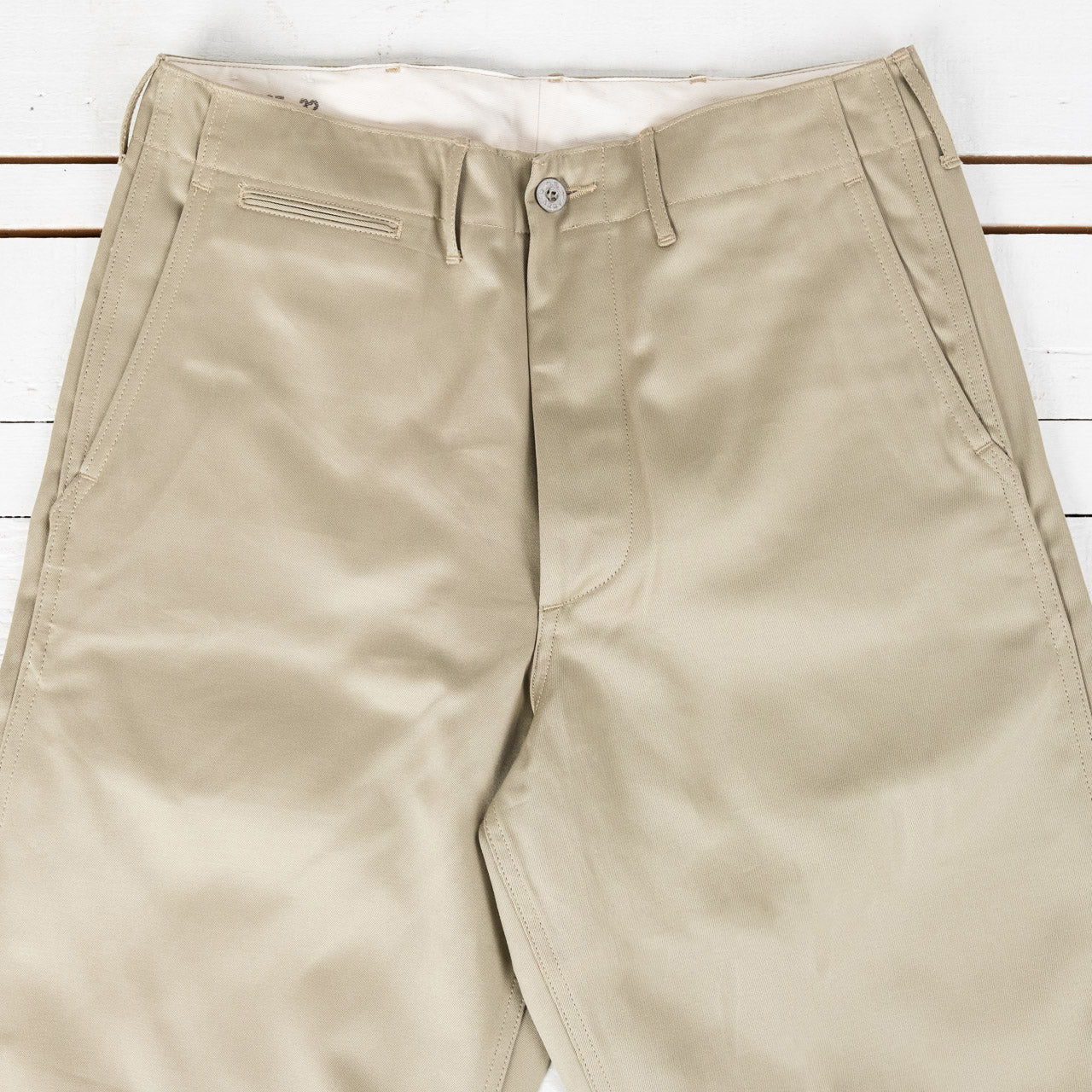
The starting point is chino cloth itself: a densely woven cotton twill descended from the fabrics used for military khaki uniforms. Look closely and you’ll see the characteristic diagonal lines of the twill weave. It offers a useful combination of strength, relatively low weight and comfort.

West Point Cloth
West Point is a close relative of chino cloth, generally woven more densely from two-ply yarns. The result is smoother, firmer and often a little more lustrous, giving it a cleaner and somewhat more formal appearance than a typical field chino.
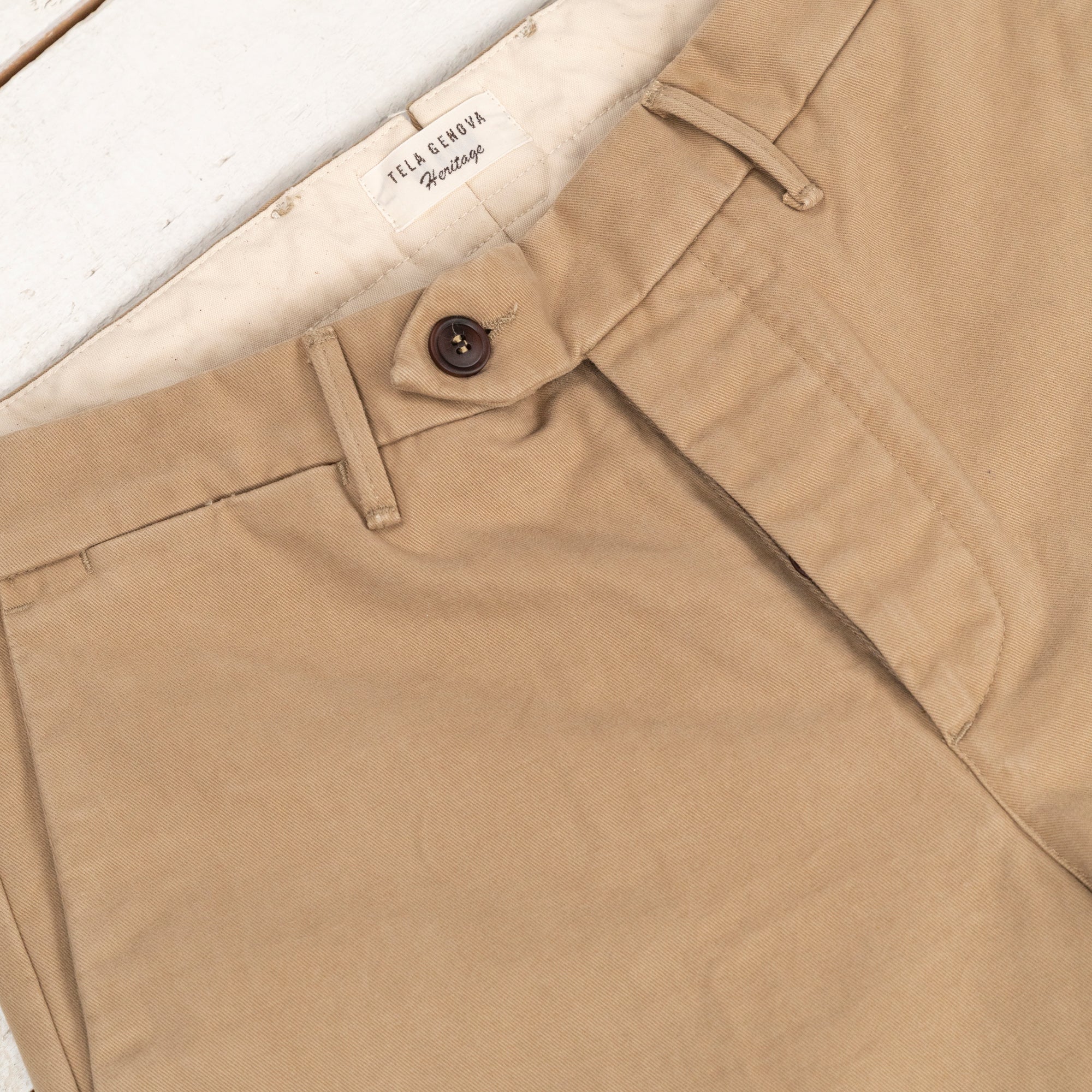
Gabardine
Gabardine takes the tightly woven twill in another direction. Its pronounced diagonal and dense construction produce a smooth cloth with a very different drape and surface from a conventional military chino.
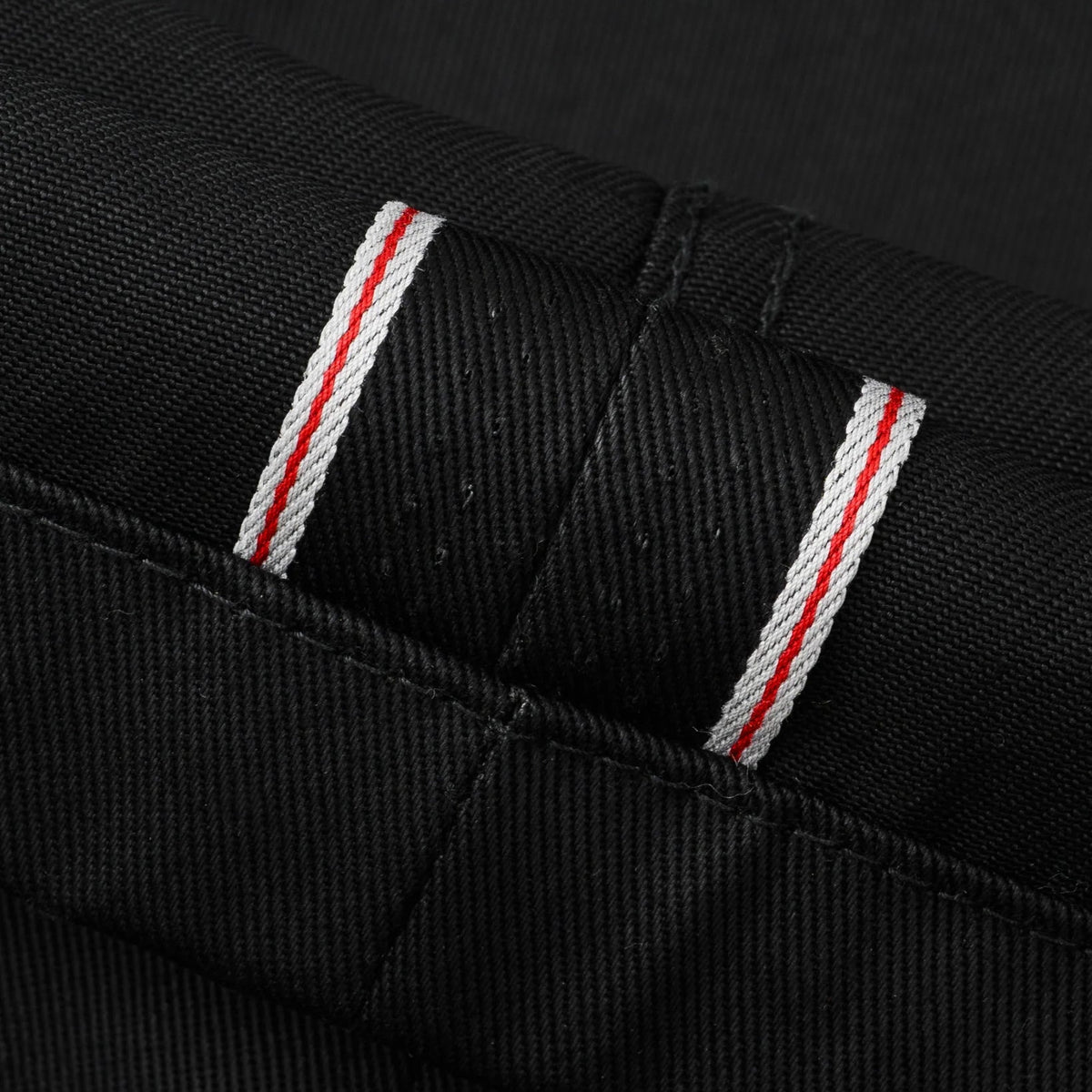
Selvedge
Selvedge doesn’t describe a particular type of chino cloth. It tells you something about how that cloth was woven. On a traditional shuttle loom the weft turns back at the edge of the fabric, creating its own finished edge.
Where makers publish weights, the trousers we carry run from around 9 oz to a substantial 14 oz. Change the yarn, weave, weight and finish and you can transform almost everything about how essentially the same trouser feels, drapes and wears.
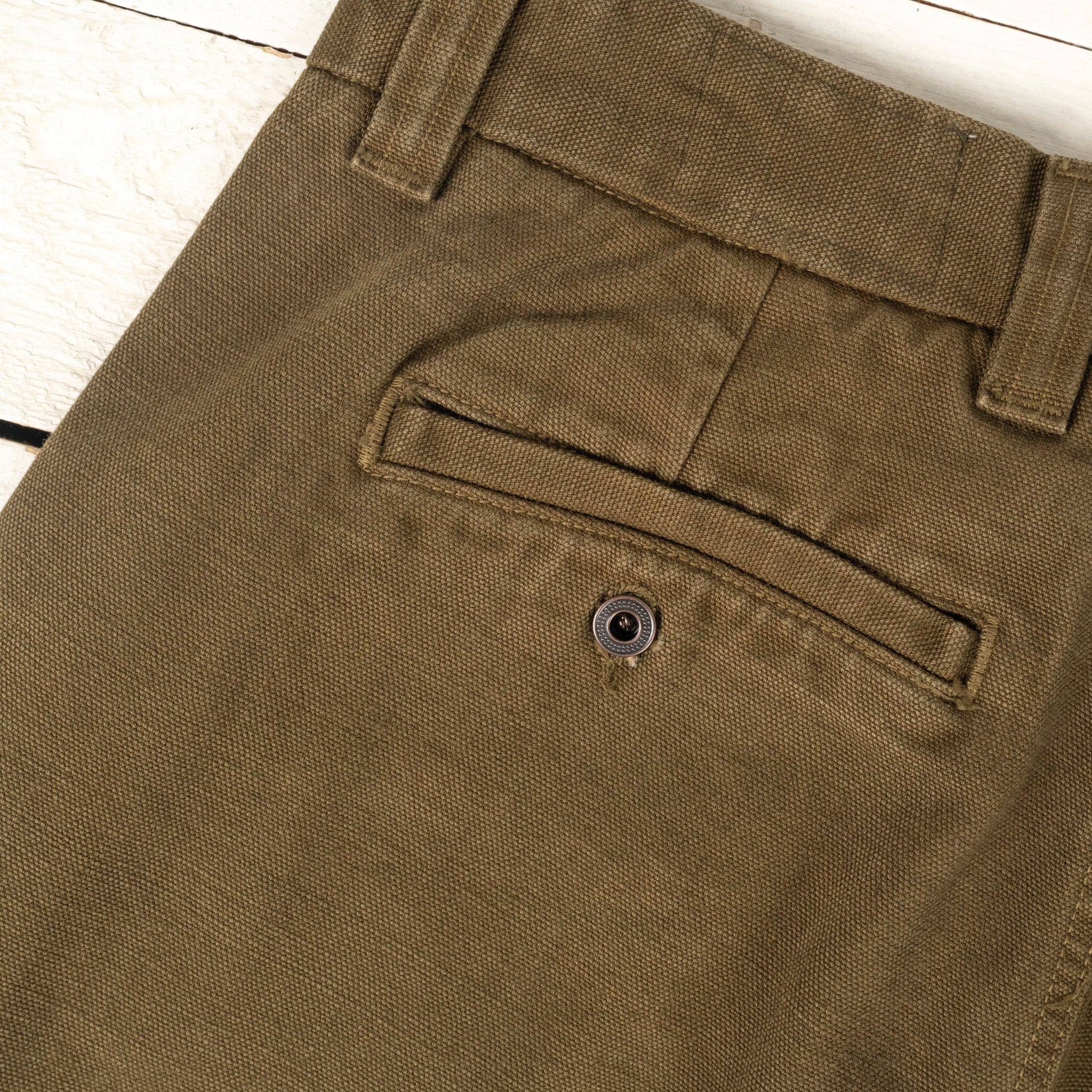
How Do Chinos Age?
There isn’t really one answer to what a chino will look like after two or three years, because washing, wear, dye and fabric all have an enormous influence.
Unlike raw denim, we generally wouldn’t expect the pronounced whiskers and honeycombs associated with a heavily worn pair of jeans. Chinos tend to change in a softer, more diffuse way.
In our experience, black tends to produce the strongest visible contrast, gradually moving towards charcoal and grey at points of abrasion. Olive becomes softer and dustier. Khaki generally ages more quietly, where the change is less about dramatic fading and more about shifts in tone, softness and surface character.
That’s part of the appeal. The ageing belongs to the person wearing them.
Sizing and Shrinkage
Sizing. The million-dollar question, and unfortunately not one with a completely straightforward answer.
Rather than relying solely on the number printed on the label, take a pair of trousers you already own, preferably the pair that fits exactly the way you like, and measure it according to our How We Measure guide. Compare those measurements with the product size chart and you will have a far better indication of how a new pair will fit than the number on the waistband can ever give you.
There is one further complication: what happens after you start wearing and washing them.
Sanforized
Sanforized means the cloth has been mechanically pre-shrunk before it became a pair of trousers. It greatly reduces potential shrinkage but doesn’t necessarily eliminate it.
Unwashed or raw
Unwashed or raw means the finished garment hasn’t yet been washed. That doesn’t automatically tell you whether the cloth itself was sanforized.
One-wash or rinsed
One-wash or rinsed means the finished trousers have already been through a wash at the factory, taking care of most of the initial shrinkage.
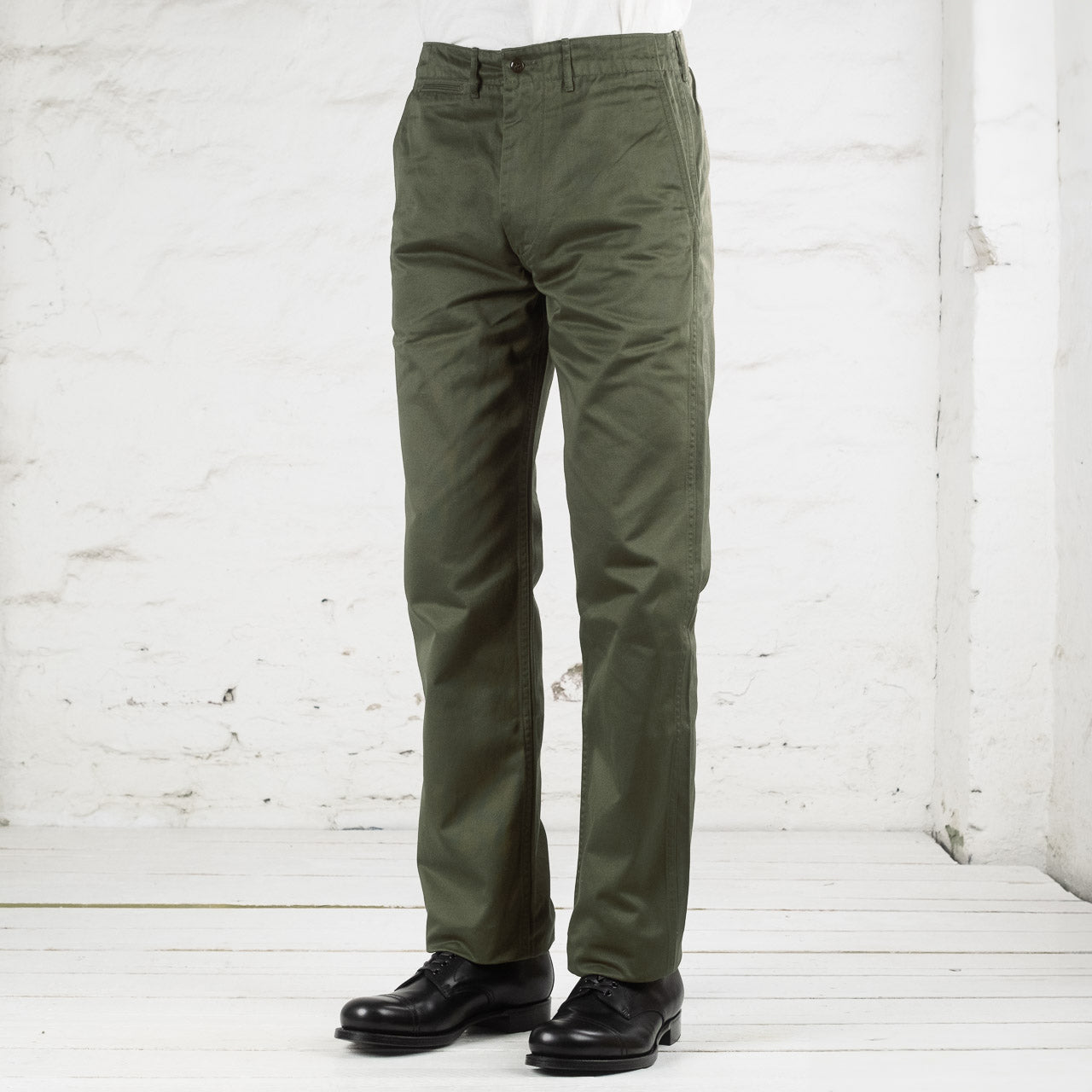
Don’t Hem Them Straight Away
If you’re buying a pair with meaningful shrinkage left in the cloth, we strongly recommend not having them hemmed immediately.
Wear them first, cuffing them if necessary so that the hem doesn’t drag, and then wash them according to the care instructions. Most importantly, wash them the way you actually intend to wash them in future.
It takes a little longer, but it greatly reduces the chance of having a perfectly hemmed pair of chinos become a rather less perfectly hemmed pair after their first wash.
And, as always, if something still isn’t clear, send us an email or give us a call.
Why Does One Chino Cost Under €200 and Another Over €300?
One thing that is easily misunderstood is the assumption that the price ladder is also a quality ladder.
The short answer is that clothing isn’t priced according to a universal quality scale.
The price of a garment is the result of everything that went into making it: how and where the fabric was developed and woven, dyeing and finishing, trims and hardware, pattern development, sewing and construction, manufacturing volume, country of manufacture and ultimately the economics of the company producing it.
What you’re choosing between are different priorities.
The useful question isn’t “Which one is better?” It’s “Which one are you actually going to enjoy wearing?”
What People Often Get Wrong About Chinos
Japanese sizing always runs small.
Sometimes it does, sometimes it doesn’t. A 32 from one maker can measure quite differently from a 32 from another, and even models from the same brand can differ. Measure the trousers, not the nationality on the label.
A wider fit means the trousers are too big.
If you size down simply to make the leg look slimmer, there’s a good chance you’ll ruin the way the waist, seat and rise are supposed to fit.
Chinos are lightweight summer trousers.
They certainly can be, but that’s only one interpretation. Within our selection you’ll find everything from relatively light cotton twills to dense West Point cloth and substantial 14 oz trousers that sit much closer to workwear.
Sanforized means shrink-proof.
It doesn’t. Sanforization dramatically reduces shrinkage but doesn’t guarantee that a cotton garment will never move when washed.
Perhaps the common thread through all four is that the label tells you less than you might think. The trousers themselves do.
Frequently Asked Questions
Which size should I order?
The number on the label only tells you so much. Take a pair of trousers that already fits you well, measure it according to our How We Measure guide and compare those measurements with the individual product size chart. If you’re between sizes or something doesn’t make sense, contact us. And if you’re in Berlin, come into the store and try them on.
How should chinos fit?
That depends entirely on the pattern. A military-derived chino may be designed to sit relatively high with a full seat and thigh and a wide leg. A more modern interpretation may be considerably closer. Choose the silhouette you actually want first, then find the size that allows that silhouette to work properly.
Do chinos shrink?
Some do noticeably; others barely move. What matters is the cloth and how the finished garment was treated before it reached you. An unwashed pair may have significant first-wash shrinkage left in it, while a one-washed pair has already done most of that work. Check the individual product page, and when in doubt ask us before hemming.
Should I wash chinos before having them hemmed?
If they’re unwashed, yes. Wash them the way you intend to wash them in future and allow the cloth to settle before deciding on the final length. With a one-washed pair, one further wash before hemming is usually more than enough.
Do chinos stretch with wear?
A little. Cotton will relax in areas under tension, particularly the waist, seat and knees, and then tighten again after washing. Length behaves differently: genuine shrinkage in the inseam is largely permanent.
What is West Point cloth?
West Point is a particularly dense, smooth cotton twill generally made with two-ply yarns. Compared with a typical chino cloth it tends to feel firmer and cleaner, with a little more lustre and structure. Different makers use the name somewhat differently, so think of it as a family of cloths rather than one rigid specification.
Button fly or zip?
You’ll find both. Military reproductions often use button flies because that is how the original trousers were constructed, while other makers use zips. Neither is inherently better. A button fly can feel rather stiff when new but becomes considerably easier with wear.
What’s the difference between chinos and khakis?
Historically, the terms overlap considerably. Khaki originally described the dusty colour and the cloth used for military uniforms, while chino came to describe both a cotton twill and trousers made from it. Today, the most useful shorthand is to think of khaki primarily as a colour and chino as the trouser. A chino can therefore be khaki, but it can just as easily be navy, black, olive or white.
Where are the trousers made?
Many of the chinos we carry are made in Japan, particularly those from brands specialising in Japanese reproduction and heritage clothing, but not all of them. Freenote Cloth cuts and sews its trousers in California using Japanese cloth, while Tela Genova manufactures in Italy. You’ll find the country of manufacture on the individual product page.
What is a watch pocket?
A watch pocket is a small additional pocket originally intended for a pocket watch. You’ll still find the detail on some historically based trousers long after the pocket watch itself disappeared from most people’s daily lives. It is one of those small details that makes considerably more sense once you know where the garment came from.